Lounge Lizard EP-4 — Electric Piano
(MAP: $189)

Once again, AAS raises the bar in recreating the classic electric pianos. Once you get your hands on Lounge Lizard, that elusive electric piano sound becomes a vivid reality.
Using AAS's award winning physical modeling technology, they've come up with refinements that take one of the most impressive and unanimously acclaimed software to another level.
AUTHENTIC TONE, ACTION, AND FEEL.
Lounge Lizard EP‑4 delivers authentic vintage electric piano sounds in an everything-you-need package.
EVERYTHING YOU NEED FROM START TO FINISH
The feeling of playing a real instrument, live or in the Studio.
|
|
|
|
UNDER THE HOOD
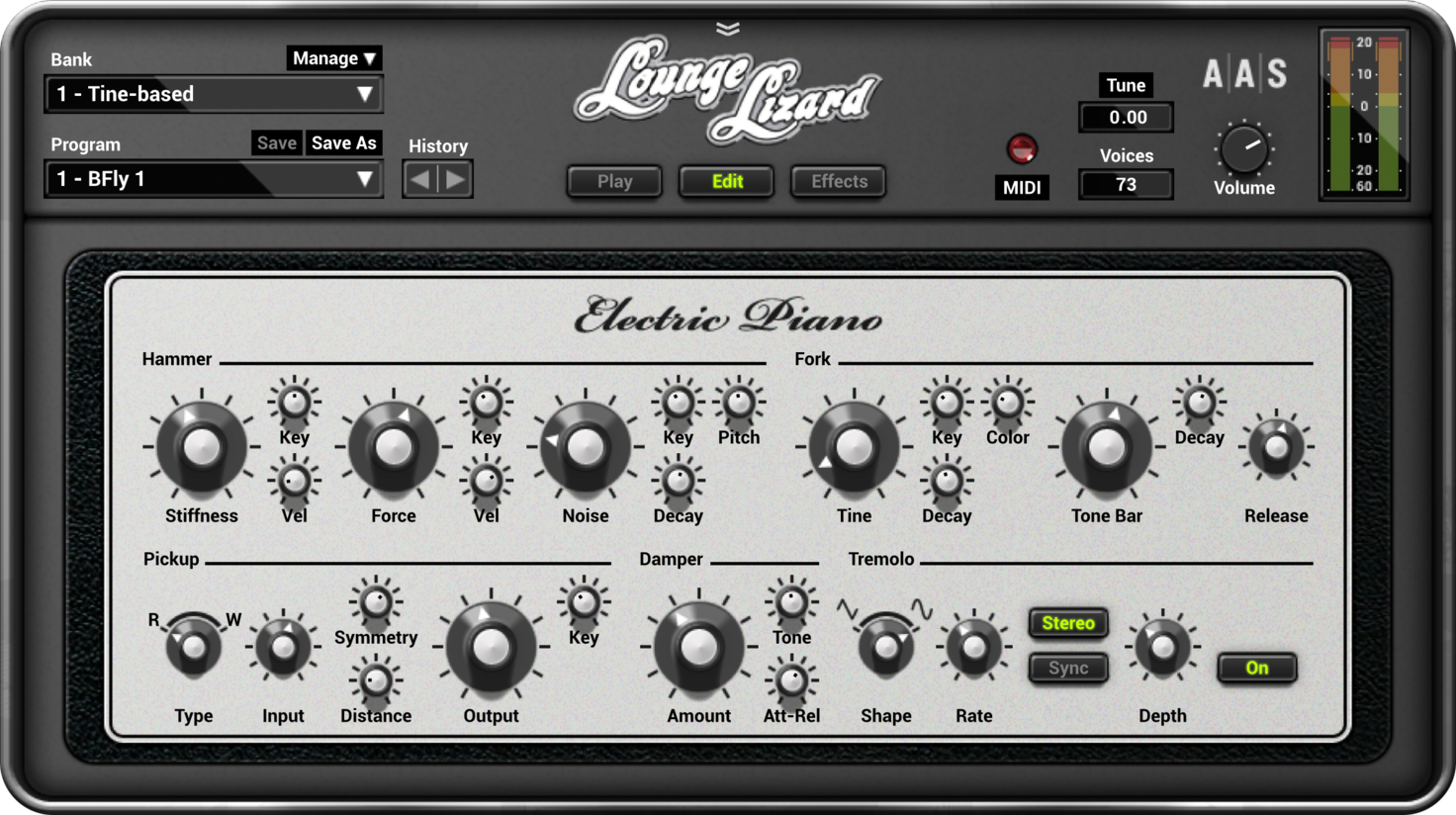
Hammer, tone, tine, pickup—Lounge Lizard is built around the modeling of real piano components. Custom pianos can be created with just a few tweaks, a job that took hours of painstaking work on real-life instruments.
|
|
|
|
|
|
FROM AUTHENTIC TO CLEVERLY PRODUCED
You’ll love the pure raw sound of Lounge Lizard EP‑4, but the built-in effects will bring it to so many places that you’ll enjoy having them on hand. And you have a chock-full of them to choose from: compressor, equalizer, delay, distortion, phaser, chorus, flanger, wah wah and notch filters, and reverb.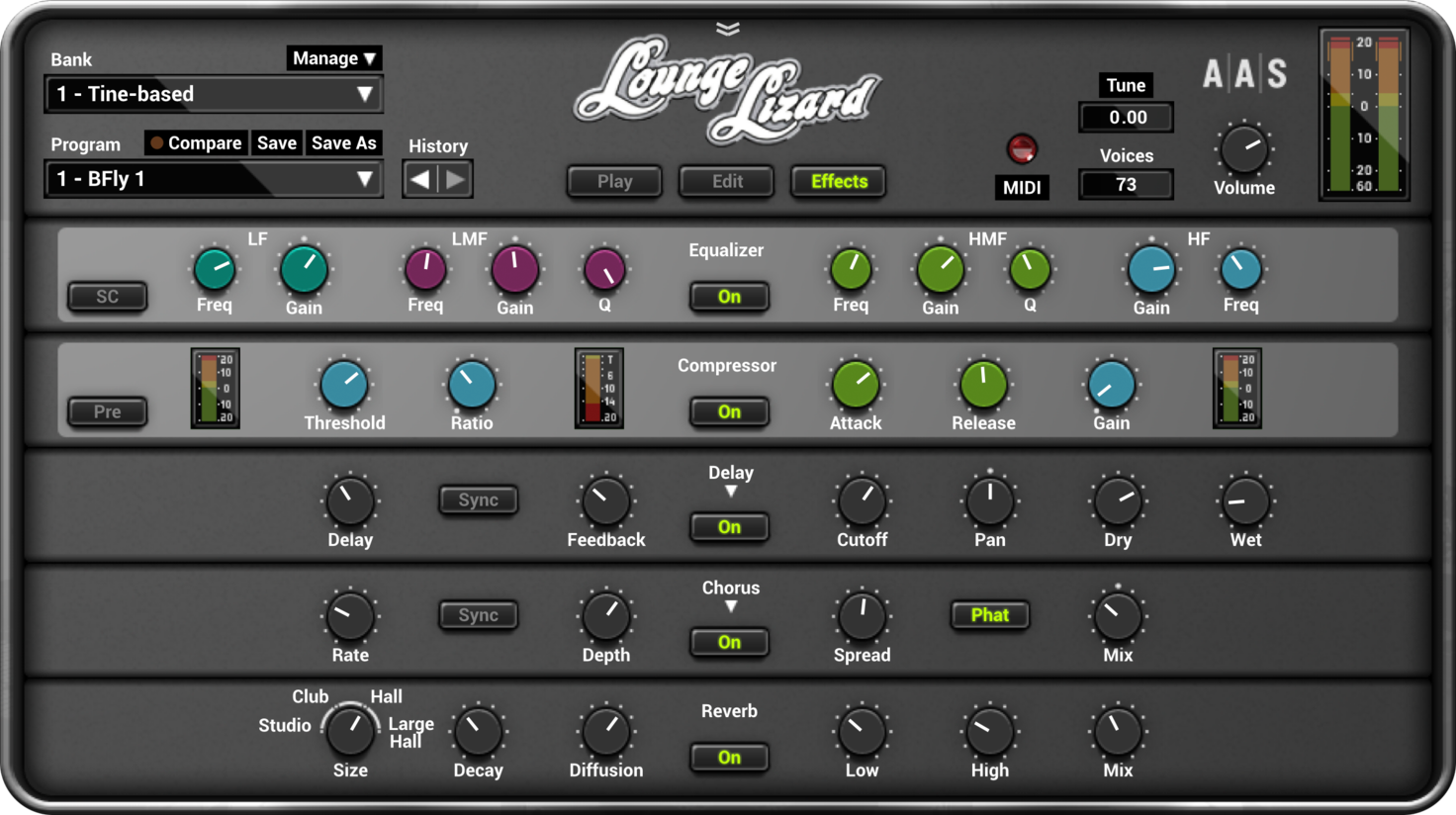
|
|
NEW Features in Lounge Lizard EP-4 to version 4.3.0
- New Library - The completely renewed factory library features classic electric piano sounds as well as over 240 gig- and mix-ready custom electric pianos making good use of the compressor, equalizer, and multi-effect processor.
- New Compressor and equalizer - These new additions are designed to add punch and definition to your sound, letting you cut through any dense mix or stage.
- New Character control - The new Character control provides five classic studio and stage signal path emulations—that's the cabinet, pre-amp, microphone, and recorder chain that follows the piano's output—to help fit your electric piano part into your track.
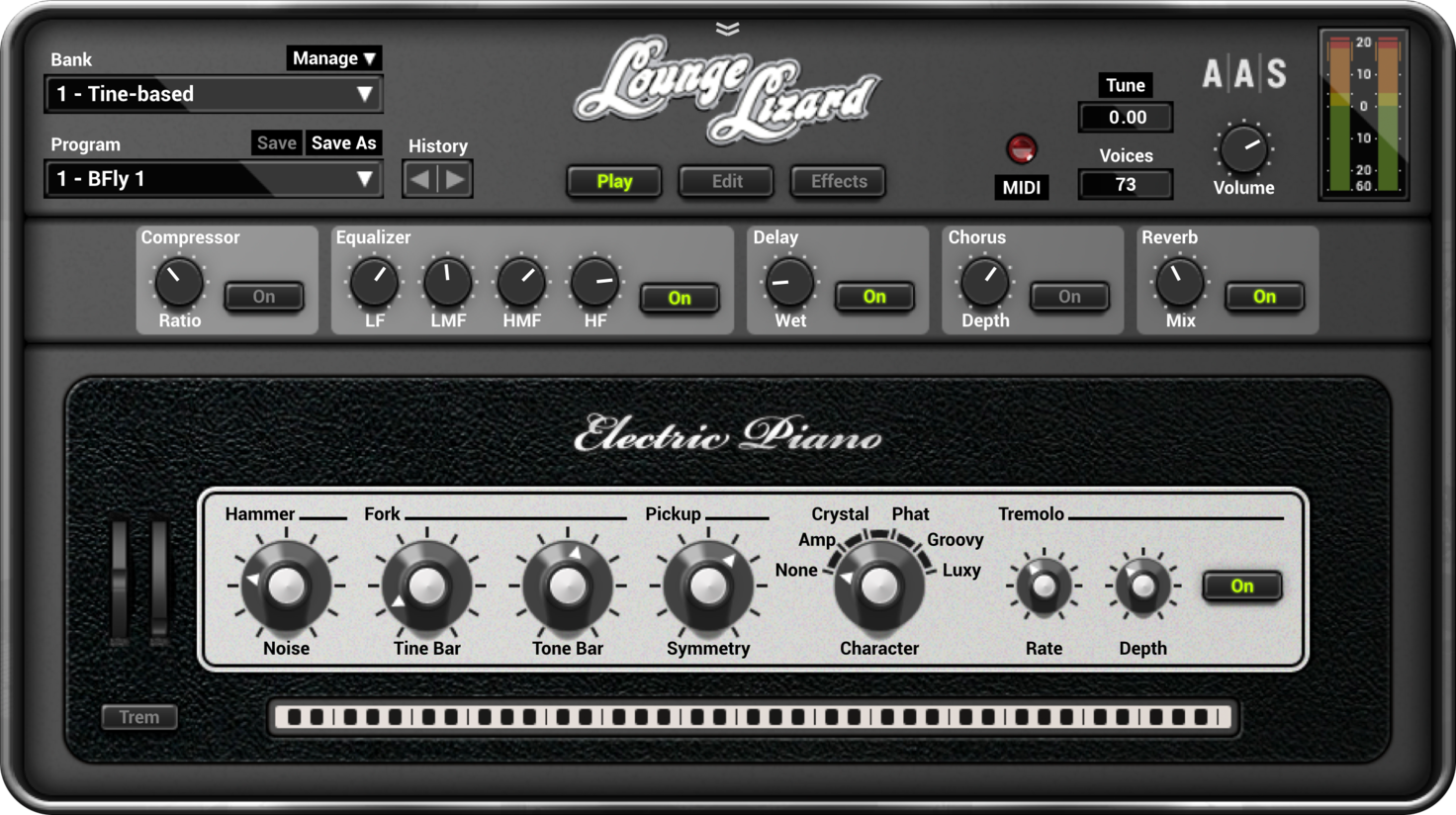
- New Streamlined interface - Redesigned from the ground up, the new interface now divides Lounge Lizard EP-4 into three panels: Play presents shortcuts to the main piano and effect parameters including bypass switches for quick edits; Edit lets you get under the hood and voice the piano to taste; while FX supplies equalizer, compressor, multi-effect, and reverb processors for final shaping duties.
- New Limiter - The new output limiter protects your ears and monitors during experimentation with the piano's physical modeling parameters while providing a maximum of distortion-free dynamics.
- New Bank and program manager - Lounge Lizard EP-4's new manager allows simple and efficient organization, backup, and sharing of your sounds.
- Overhauled effects - Reinvigorated, polished, and tuned especially for the electric piano, Lounge Lizard EP-4's multi-effect processor features our best sounding chorus, delay, phaser, flanger, distortion, notch filter, wah-wah, auto-wah, and reverb to date.
- New Microtonal tunings via Scala scale files - Lounge Lizard EP-4 now supports the Scala scale file format for microtonal music making.
- Resizable user interface
Other Key Features of Lounge Lizard EP-4:
- The brand new modeling library fully exploits the refinements and covers all your electric piano needs
- The high-end effects section has been extended with tremolo, wah, chorus, phaser, delay, reverb, and EQ making Lounge Lizard a complete and self-contained electric piano solution
- Two pickup types are now available for a wider character range: electromagnetic and electrostatic. In addition, scaling has been added for even volume across the entire keyboard
- The new and improved Fork model adds upper harmonic content for an even more authentic sound
- The improved Damper now closely interacts with the Fork and provides superb dynamic response
- The integrated Audio Recorder captures inspired moments on the fly
- Custom tunings are now possible with the added support for Scala files
- All the classic electric piano sounds
- Entirely based on physical modeling for outstanding sound quality
- Top quality preset library—vintage to modern
- Integrated browser and locate function for easy navigation and organization of presets
- Fast preset loading time
- Hands-free operation via custom MIDI programs
- Every parameter can be controlled via MIDI or host automation
- Intuitive and ergonomic user interface for preset creation
- Fast installation
- Real-time calculation of sound. No samples
- 32bit floating point internal processing
- Sample rates up to 192 kHz
- Import/Export functions for easy sharing of presets
- Unlimited undo/redo capability
- Standalone operation. No host application required, and standard plug-in format support
- Full audio and MIDI hardware support
- Simultaneous operation of multiple MIDI ports
- User defined MIDI maps with MIDI Learn function
- MIDI clock, tap and host tempo synchronization
- Dynamic voice allocation and CPU overhead protection
Presets and Effects
Lounge Lizard comes with an extensive preset library that is simply inspiring, giving you access to the classic electric piano sounds popularized by musical legends like Chick Corea, Herbie Hancock, Stevie Wonder, and George Duke. There is a choice of pure and true tones as well as a selection of processed ones courtesy of the high-end effects section.
The effects section includes the classic tremolo, chorus, wah, and phaser effects as well as EQ, delay and reverb. These effects are specially designed for the electric piano, making it very easy to create your own distinctive custom tones.
Take It Further
Expand Lounge Lizard’s sonic capabilities with the Sound Pack Series. Available to purchase as individual titles or as part of the Lounge Lizard + Packs Bundle. With over 330 presets at your fingertips, these sound packs offer an endless source of inspiration.
 Space Walk |
 Caffeine |
 Insomnia |
EP Character and Beyond
The original electric pianos provided timbre and volume adjustments by letting you position the tines in relation to the pickups. These adjustments were at the heart of the electric piano's character as they controlled the harmonic content, attack, and decay of the sound, offering unique tone to each player. But there was a price for this flexibility. Several painstaking hours with a screwdriver and incredible patience was needed to change the sound of an electric piano.
Suffer no more! With Lounge Lizard, the preset library provides a selection of thoroughly chosen Tine/Pickup configurations. You also have the ability to make those adjustments in real time via two simple controls: Distance and Symmetry.
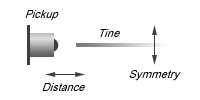
It doesn't end there. Because controls are provided for the various electromechanical components, Lounge Lizard can be pushed far beyond hardware equivalents, opening up a completely new realm of sonic possibilities!
What's more, since the interaction between the tine and pickup is quite unique, its effect can't be obtained with the filtering provided by samplers. This limits sampled solutions to one or two fixed configurations and brings physical modeling to the forefront of the electric piano recreation.
Modeling an Electric Piano: How it works
The electric piano was invented by Harold Rhodes (1910-2000) during the forties when he was in the army. The first instruments he built were made of aircraft pieces and were intended to entertain army servicemen. It became a very popular instrument in jazz and rock, and has enjoyed a resurgence in recent years through it's extensive use by the world's top hip hop, R&B, and house producers.
The mechanism of the electric piano is, in fact, quite simple. A note played on the keyboard activates a hammer that hits a fork. The sound of that fork is then amplified by a magnetic coil pickup and sent to the output, very much like an electric guitar.

System Requirements
Mac minimum system requirements*
- macOS 10.13 (High Sierra) or later
- Intel Core i5 (circa 2015), Apple M1 processor or later
- 64-bit DAW
PC minimum system requirements*
- Windows 10 64‑bit or later
- Intel Core i5 (circa 2015) processor or later
- 64-bit DAW
*The minimum system requirements mentioned above are for standalone usage. For plug-in usage, please refer to your DAW software requirements (Sonar, Pro Tools, Cubase, Live, Digital Performer, Logic Pro, etc.)
Lounge Lizard EP-4 is also part of the AAS Modeling Collection.
